
 我的收藏
我的收藏
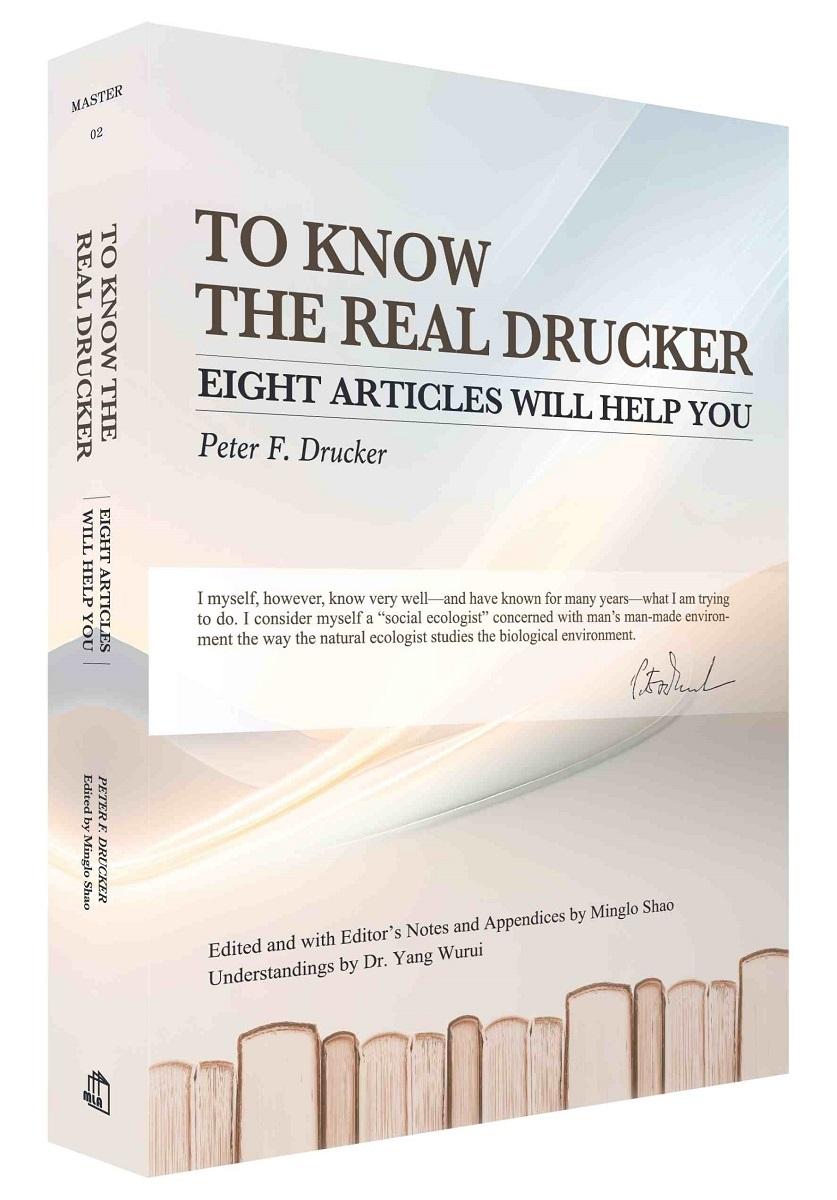
To Know the Real Drucker: Eight Articles Will Help You
定價 $440
79折優惠價 $348(優惠期限至9999/12/31)


內容簡介
This book is strongly recommended to entrepreneurial decision makers who are looking for a way to implement Drucker’s ideas.
Decision makers not only need to have a theory of knowledge, but more importantly, a new worldview. In To Know the Real Drucker: Eight Articles Will Help You, we get a glimpse of how Drucker thought as a management guru and social ecologist, as well as his thinking process.
To Know the Real Drucker: Eight Articles Will Help You is a collection of eight articles by Peter Drucker: “The Unfashionable Kierkegaard” (1949) and its introduction (1992), “The New World-View” (1957), “From Analysis to Perception: The New World View” (1989),“Reflections of a Social Ecologist” (1992), “What Is a Functioning Society?” (1942), “From Rousseau to Hitler” (1942), “The Human Situation Today” (1957), and “Management as Social Function and Liberal Art” (1989).
Readers can find the source of each articles in the table of contents and editor’s note per article. Of the eight articles, only the last one is from Drucker’s works on management. The other seven are from his books on society, politics, and economics. Although the world has hailed him as the “Father of Modern Management,” he considered himself a “social ecologist.” This book will play an indispensable role in explaining the reason for that and in further understanding the foundation of faith and worldview which Drucker’s social ecology (and, of course, management) is built on.
作者介紹
Peter F. Drucker (1909-2005)
was raised in a culturally rich family environment and was influenced by the Judeo-Christian tradition. He immigrated to the United States in 1937 and was awarded the Presidential Medal of Freedom on June 20, 2002.
A lifelong writer, Drucker is world-renowned for his more than 40 books. He studied finance in his early years and received a doctorate of law from the University of Frankfurt in 1931. He admired John M. Keynes (1883-1946) but was a follower of Joseph A. Schumpeter (1883-1955). Politically, he was highly critical of totalitarianism.
As a “social ecologist,” Drucker had keen insights and the courage to pursue innovation despite criticism. He established modern management discipline, advocating theoretical innovation and practical inquiry into management issues. Thus, he has been acclaimed as the “Father of Modern Management” and the “Guru of Gurus of Management.”
Drucker lived for nearly a century. He experienced two world wars, witnessed the processes of scientific, technological and ideological changes, observed the changes that took place from the industrial age to the intellectual (knowledge) and information ages, experienced the transformation from a capitalist society to a postmodern knowledge-based society, and offered prescient insights into world trends and human growth in the 21st century. We can say that his contributions will not be limited to the 20th century; his work will undoubtedly have an even more positive and far-reaching impact on developments and changes in the world’s future.
Minglo Shao(編訂者)
An entrepreneur and management educator, Mr. Shao was authorized by Peter Drucker and his family to establish the Peter F. Drucker Academy in Taiwan, Hong Kong, and mainland China to promulgate Peter Drucker’s Management as Social Function and Liberal Art (MLA) theories and practices. He is the editor of Drucker on Totalitarianism and Salvation by Society
目錄
Forward The Way of Drucker’s Management Philosophy 009
Editor’s Forword 021
PART ONE
The Mundane Christian Faith: The End of Values, Commitment, Conviction and Aspiration 031
ARTICLE 1 Introduction & The Unfashionable Kierkegaard
(Abstracted from The Ecological Vision, Part 8: Why Society Is Not Enough) 033
Appendix 1
Nineteen Questions Regarding Reading The Unfashionable Kierkegaard” 059
An Understanding 065
PART TWO
The Worldview That Keeps Up with Reality: Purpose-Oriented Methodology 077
ARTICLE 2 The New World-View
(Abstracted from Landmarks of Tomorrow, Chapter 1) 079
Appendix 2
Ten Questions Regarding Reading “The New World-View” 100
An Understanding 103
ARTICLE 3 From Analysis to Perception: The New World View
(Abstracted from The New Realities, Conclusion) 117
An Understanding 132
PART THREE
Drucker’s Social Ecology: The Application of Faith and Worldview 141
ARTICLE 4 Reflections of a Social Ecologist: The Social Ecology’s Themes, Work and Characteristic (Abstracted from The Ecological Vision, Afterword) 143
Appendix 3
Eleven Questions Regarding Reading “Reflections of a Social Ecologist” 171
An Understanding 175
ARTICLE 5 What Is a Functioning Society? —The General Theory of Society
(Abstracted from The Future of Industrial Man, Chapter 2) 181
An Understanding 202
ARTICLE 6 From Rousseau to Hitler: The Lesson from History
(Abstracted from The Future of Industrial Man, Chapter 7) 215
Appendix 4 Peter F. Drucker’s View on Freedom 243
An Understanding 259
ARTICLE 7 The Human Situation Today: Upcoming Challenges
(Abstracted from Landmarks of Tomorrow, Chapter 10) 267
An Understanding 286
PART FOUR Management as a Liberal Art: The Means to Achieve Social Ecological Vision 295
ARTICLE 8 Management as Social Function and Liberal Art: The Field, Legitimacy,
Principles and Characteristic
(Abstracted from The New Realities, Chapter 15) 297
An Understanding 313
PART FIVE Reflection:
The Eight Essential Quotes of Drucker— The Most Fundamental Beliefs and Values in His Social Ecology and Management as a Liberal Art 321
序/導讀
To Know the Real Drucker: Eight Articles Will Help You, edited by Minglo Shao
Mr. Minglo Shao is a Chinese entrepreneur with a strong innovative spirit. China reformed its economy and opened to the world in the 1980s. Since then, Mr. Shao has founded successful companies in real estate, logistics services, management consulting and training and other fields. As founder of the Peter Drucker Academy, he has administrated, studied, and taught Peter Drucker’s thoughts for over 20 years. Mr. Shao believes that “all of Drucker’s works are one book,” reflecting his interpretation of Drucker’s holistic philosophy, which encompasses society, community, government, and management, integrating the four themes into a whole.
Mr. Shao was one of twelve participants involved in creating the manuscript of Peter Drucker’s Managing in the Next Society (2002). In recent years, Mr. Shao has devoted himself to researching Drucker’s management philosophy, attempting to “interpret Drucker’s thought in Drucker’s language,” publishing the compilation Drucker on Totalitarianism and Salvation by Society (2021). In To Know the Real Drucker: Eight Articles Will Help You, he borrowed the mode of discussion and writing Drucker employed in Managing in the Next Society.
Beginning in August 2022, Mr. Shao organized seminars themed on the eight articles in this book, and I had the honor of participating in discussions of relevant chapters. To Know the Real Drucker: Eight Articles Will Help You is the second book Mr. Shao has edited. The manuscript ultimately focused on “management as a social function and liberal art,” attempting to open the way to understanding Drucker’s thought via the spiritual dimension and new worldview philosophy dimension.
The book has four parts: Part one deals with faith. “The Unfashionable Kierkegaard” introduces readers to Drucker’s spiritual world and serves as an entry point into his system of thought. This approach is challenging, posing difficulties for those unfamiliar with Western religious thought have not yet developed religious beliefs. But once one comprehends the idea that “man exists both in the social dimension and in the spiritual dimension,” as Drucker proposes, it opens the door to his philosophical system.
The second part deals with worldview. Drucker argues for a holistic new worldview in the philosophical area in two articles: the first is based on changes in social phenomena in the United States in the early postwar period, proposing a corresponding “the new world-view of a configuration” (Landmarks of Tomorrow, 1957). The second looks at worldwide social phenomena at the end of the Cold War, advocating for “From Analysis to Perception: The New World View.” (The New Realities, 1989).
The third part is the application of religious faith and worldview. Kierkegaard believed that “human existence is possible as existence not in despair, as existence not in tragedy; it is possible as existence in faith.” When people have faith, they are both individuals in the spiritual dimension and citizens in the social dimension. Only when individuals (including entrepreneurs) face society’s imperfections in faith can they confront difficulties and endure despair; only then can they persist in their mission. Drucker regarded the two articles on worldview as essential methods for perceiving and analyzing different social ecologies, including industrial society, knowledge society, entrepreneurial society, and nonprofit social organizations (the social sector). Regardless of the stage or form of social development, Drucker’s social-ecological vision is consistent; that is, to build a tolerant, functioning society in the face of social imperfections.
Part four gives full play to management’s function in establishing an effective operational social ecology organization. In 2023, I proofread the archives of Mr. Shao’s conversations with Peter Drucker. Mr. Shao recalled that Drucker once told him that “The rapid development of competent managers and entrepreneurs capable of competing with the world’s best, is surely China’s greatest need, and the key to the country’s social and economic success.” Peter Drucker was long concerned with China and kept in touch with Chinese entrepreneurs, students studying abroad, and scholars such as Mr. Shao.
China’s rapid development after joining the World Trade Organization (WTO) in 2001 confirmed Drucker’s expectations, and China has produced its own group of entrepreneurs. The depth of Drucker’s new worldview research has influenced entrepreneurs’ understanding of his management principles, determining whether the correct concepts can be successfully implemented in the corporate organizational ecology. As an entrepreneur, Mr. Shao is one of the few Chinese to have personally studied with Peter Drucker. After long practice and exploration, he has forged a way for future entrepreneurs and managers to learn Drucker’s comprehensive philosophy, that is, the spiritual dimension of Kierkegaard’s existentialism and the holism of the new worldview.
I strongly recommend this book to entrepreneurial decision makers who are looking for a way to implement Drucker’s ideas. Decision makers not only need to have a theory of knowledge, but more importantly, a new worldview. In To Know the Real Drucker: Eight Articles Will Help You, we get a glimpse of how Drucker thought as a management guru and social ecologist, as well as his thinking process. If Chinese entrepreneurs wish to develop enterprises of their own, there is no better reference than this.
To Know the Real Drucker: Eights Articles Will Help You entry point is the holistic philosophy of the new worldview. It provides comprehensive and systematic understanding of Drucker’s management philosophy. It is Mr. Minglo Shao’s latest exploration and achievement.
Dr. Jack Liu, Professor,
College of Humanities of Social Science,
California State University, Fullerton Los Angeles, California
January 22, 2023 (Chinese Spring Festival)
內文試閱
Article 1
Introduction & The Unfashionable Kierkegaard
│ Editor’s Note │
When Drucker first read Kierkegaard, he was not yet 19 years old. He published “The Unfashionable Kierkegaard” in 1949 when he was 40. He included the article at the end of Men, Ideas, and Politics in 1971. In 1992, Drucker again used the article as the last chapter of The Ecological Vision andwrote an introduction to it. This part is titled “Why Society Is Not Enough?”.
Appendix 1
Nineteen Questions Regarding Reading “The Unfashionable Kierkegaard”
Question 1
What is “human existence”? What are the similarities and differences between human existence and human survival? Do humans have any existence other than that in society?
Question 2
How do you understand the statement “human existence is possible only in tension—in tension between man’s simultaneous life as an individual in the spirit and as a citizen in society.” Talk about your experience in this respect. When Drucker was nineteen years old, he realized he had a spiritual existence beyond society. Do you also have a spiritual existence? At what age and how did you discover it?
Question 3
What is freedom? What is the relationship between freedom and “human existence”? Are liberty and equality the same thing? Is freedom important to you? Why? Can you accept a life 060 061 where everyone is equal but cannot make personal choices in important matters?
Question 4
What is the relationship between time and eternity? Can eternity be measured and broken down into time? Can accumulated time become eternity? The article discusses St. Augustine’s and Kierkegaard’s differing views on this. With whom do you agree? Why?
Question 5
The New Testament (Luke 14:26) says, “If anyone comes to me and does not hate father and mother, wife and children, brothers and sisters—yes, even their own life—such a person cannot be my disciple.” What is your understanding of this passage? Share your personal experience.
Question 6
What constitutes morality and benevolence “in the sight of God”? How is it different from what people usually think of as virtue and charity? Please give an example.
Question 7
Nineteenth-century optimism believed that human society inevitably progresses and that truth could be established through continuous trial and error and majority rule, thus leading to a perfect or near-perfect harmonious society. Do you agree with this view? Why or why not?
Question 8
How did the optimists view tragedy and death? How did they keep individuals from feeling despair as death approaches? Why did Drucker say optimism “only leads to totalitarianism”?
Question 9
What is the essential difference between totalitarianism and earlier historical tyrannies? What are totalitarianism’s aims and consequences?
Question 10
How would you evaluate the role of liberalism (the rational liberalism established by the Enlightenment and the French Revolution), Darwinian evolution, and scientism in promoting social progress? What are your views on Hegel’s “thesis, antithesis, and synthesis” dialectic? How do Marx’s dialectical materialism and scientific communism relate to the above theories?
Question 11
How does Drucker evaluate the nineteenth-century German idealist philosophical system and moral culture represented by Kant and Hegel? Are there any similarities between their views and Confucian ethics? What are the positive contributions of Eastern and Western ethics in real life, and what negative consequences have they brought?
Question 12
How do you understand the statement “... in all cases the ethical position is bound to degenerate into relativism?” What is moral relativism? Give an example to illustrate the idea that “a position that starts out ... to establish man-made ethical absolutes must end in the complete denial of the possibility of a truly ethical position.”
Question 13
Why did Drucker believe that “the opposite of Sin (to use the traditional term for existence purely in society) is not Virtue; it is Faith”? What does this passage mean: “... if virtue is to be found in man, everything that is accepted by man must be virtue”? Does Drucker disagree that virtue restrains evil and prevents tragedy?
Question 14
What is faith? How does it differ from what we usually call beliefs? Share your understanding of Drucker’s views on faith. And how do you understand Abraham’s behavior? (“Abraham’s behavior” here refers to Kierkegaard’s Fear and Trembling, which deals with the Biblical story of Abraham being called on to sacrifice his son to God.) And how do you understand this passage: “... man is creature (not autonomous, not the master, not the end, not the centre) and yet responsible and free”?
Question 15
How can you gain faith? What is the so-called “saintliness” in religion? How is this different from what we usually term “virtues”? If a person doesn’t achieve “saintliness,” can he or she still live in faith?
Question 16
Kierkegaard believed that “human existence is possible as existence not in despair, as existence not in tragedy; it is possible as existence in faith.” Does he mean that with faith, the tension between the individual on the spiritual level and the citizen on the social level can be eliminated?
Question 17
Drucker criticized the “Yogis” and “Commissars” in the article. What are some examples of these two types of people today? What are some current examples of the European “Christian” political parties, Protestantism, Catholicism, and the influential “Christian Socialist” movement in the United States that Drucker criticized in his day? Where are they wrong? If atheists and materialists are truly noble and sincerely try to do good, can they change the world, help others, and live out the meaning of their own lives?
Question 18
Drucker said “The Unfashionable Kierkegaard” was “written out of despair” and “to affirm hope.” What was he despairing of? Society? Human life? Human nature? Where does hope come from? Why did he believe that “society is not enough— not even for society”?
Question 19
What is Drucker’s view of nineteenth-century humanism? Is it correct to define Drucker’s Management as a Liberal Art “people-based” and “humanized management”?
An Understanding
In a letter responding to Rosabeth Kanter, among others, Drucker said his intellectual ancestry could not be traced to the sociologist Max Weber but to Søren Kierkegaard— someone Weber had probably never even read. He intended to correct a misconception: some people believed that Drucker, as a management scholar, focused on society alone in his whole life and therefore knew little about human nature or religion. Drucker said that his life’s work began with the lessons learned from Kierkegaard: to safeguard society, society alone is not enough.
In a 1992 introduction to “The Unfashionable Kierkegaard,” Drucker said the article was “written out of despair.” For firstly, it was conceived, written, and published during World War II, a time when humanity had fallen into profound despair. Secondly, one of the article’s themes is the exploration of the spiritual roots of the general despair then pervading society. Finally, the article aimed to clarify the faith tradition to which Kierkegaard belonged, thereby reaffirming hope.
Like Drucker’s other best writings, this article has a dual theme: while discussing faith, he diagnoses totalitarianism.
He doesn’t intend to give a textbook definition and answer to the question “What is faith?” Instead, by dissecting totalitarianism, Drucker helps readers realize what faith is not and what poses a threat to it. Moreover, he wants readers to understand that the forces that endanger faith also threaten human existence. It would have been difficult for readers in the 20th century to regain their faith through a theological treatise prattling about faith. But they did keenly feel the pain of the existential crisis brought about by totalitarianism. And, in the starkest way, Drucker’s diagnosis of totalitarianism presents the pain. This is not metaphysics or empty talk, but actual lived experience. Only through authentic lived experience can modern readers, who have long accustomed to disparaging, despising and disdaining faith, truly realize that what they need is not to judge faith as outsiders but to rebuild their connection with faith as unique individuals. Cutting off the faith dimension from existence is actually the spiritual cause of totalitarianism’s rise.
 所有書籍
所有書籍  商業理財
商業理財  親子教養
親子教養  文學小說
文學小說  人文科普
人文科普  藝術風格
藝術風格  心理勵志
心理勵志  健康生活
健康生活  飲食食譜
飲食食譜  資訊語文
資訊語文  漫畫
漫畫 


